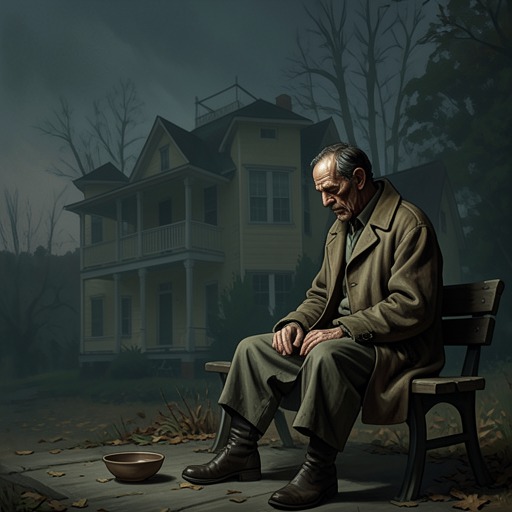
La casa lugubre e buia, dove non si mangia e non si beve
Lazarillo de Tormes“The gloomy, dark house where no one eats or drinks” is the phrase that gives the squire’s impoverished lodging its defining identity and turns hunger into a recurring verbal image. First it is his explanation for why life there is unbearable; then a widow uses nearly the same words to describe the destination of her dead husband, and Lázaro mistakes her lament for a literal description of their home. In that collision of want, pride, and mishearing, a phrase about deprivation becomes the engine of a comic scene.
A House Named by Its Deprivation
The phrase belongs to the episode in which Lázaro serves the poor squire. Hunger is not an abstract condition in this household: Lázaro reflects that, unlike his earlier masters, this one has no means to feed him, and that he sometimes brings home food at the cost of barely feeding himself. His compassion for the squire coexists with the bodily fact of their shared scarcity.
The squire nevertheless seeks to preserve his honra. He goes out to the doorway with a straw between his teeth, pretending to pick them after eating, although there is nothing to pick. His complaint that the house is gloomy, dark, and unlucky shifts the apparent cause of his suffering from poverty to the dwelling itself. He insists that once the month is over they will leave; the house becomes a convenient object of blame, while the empty mouth and the straw disclose what the performance conceals.
The lodging’s deprivation has a material rhythm. When the squire obtains a real, he gives it to Lázaro to buy bread, wine, and meat, announcing that they will eat like princes. The money briefly promises a meal and a new lodging, but the words associated with the house outlast that moment of hope. Its defining image is not simply darkness: it is the conjunction of a bleak interior with the repeated absence of food and drink.
The Widow’s Lament and Lázaro’s Mistake
As Lázaro walks toward the market with the real and a jug, he encounters a funeral procession carrying a dead man on a bier. Behind it, the dead man’s wife walks in mourning and cries out about where her husband is being taken: to the gloomy, dark house where no one eats or drinks. Her words refer to the destination of the funeral procession, but they echo so precisely the squire’s account of their lodging that Lázaro hears them as a warning about his own home.
Lázaro cries that the dead man is being brought to his house. Back at the lodging, he tells the squire what he has heard and bars the door, bracing his shoulder against it while the procession passes. Even after the funeral has gone by, he remains wary that it may be brought inside. The widow’s lament has transformed a familiar description of poverty into an immediate, literal threat in his mind.
The squire, despite having few grounds for cheer, laughs so hard that he cannot speak for a while. His laughter follows the mismatch between the widow’s words and Lázaro’s interpretation: the phrase is accurate as a description of the household’s deprivation, but it does not mean that a corpse is about to be carried through their door. Once the procession has passed, the squire tells Lázaro to open up and fetch food. Lázaro asks him to wait until it has turned the corner, extending the joke through his continued caution.
Repetition, Hunger, and Comic Reversal
The phrase’s force comes from recurrence. The squire first uses the house’s gloom as an explanation for his plight and a reason to anticipate moving; the widow’s funeral lament then repeats the image in another context. Because Lázaro has lived inside the conditions the phrase names, he does not hear it as figurative or incidental language. He takes it as concrete information about where the dead man is going.
That mistake briefly reverses the household’s everyday relation to hunger. Lázaro had set out to buy food with a rare coin, imagining a meal after prolonged want; the funeral words make him fear that death, rather than dinner, is approaching the house. The procession does not enter, and the food errand can resume, but the interval between promise and panic exposes how completely scarcity governs his expectations.
The squire’s concern for honra and Lázaro’s bodily need give the phrase two related meanings. For the squire, the house is a public-facing excuse: he can complain about its ill fortune while staging the appearance of a man who has eaten. For Lázaro, its defining truth is immediate and literal, made sharper by his memories of masters who had resources but kept food from him. The comic misunderstanding therefore does not cancel the hardship. It lets the same words carry both the squire’s self-protective performance and Lázaro’s hungry, practical fear.
A Verbal Image of the Episode
The house is characterized less through architectural detail than through the words spoken about it and the consequences of hearing them. Gloom and darkness furnish the squire with a complaint; the absence of food gives that complaint its material basis; the widow’s echo turns it into a plot mechanism. A verbal description becomes an event because Lázaro, already shaped by want, treats it as a literal report.
The phrase thus concentrates the episode’s contrast between appearance and necessity. The squire preserves the form of dignity with a straw between his teeth, while Lázaro guards the door against a funeral and then waits for the procession to turn the corner. Their house is comic because the feared corpse never arrives, but its association with a place where no one eats or drinks is not disproved: it remains the household’s lived condition, and the reason the prospect of a real meal matters so much.